Why Thick Plate Laser Cutting Produces Heavy Bottom Dross — And Why It’s Often NOT a Power Issue
- milouwan1101
- May 17
- 5 min read

In thick carbon steel laser cutting, operators often assume poor cutting quality is caused by insufficient or excessive laser power. In real production, many defects come from process stability issues: focus deviation, nozzle instability, gas flow disruption, coaxial misalignment, and optical contamination.
We recently analyzed a thick-plate cutting case where the customer believed the machine had a “power problem.” After reviewing parameters and the physical cut results, the real causes were completely different.
The Customer’s Original Problem
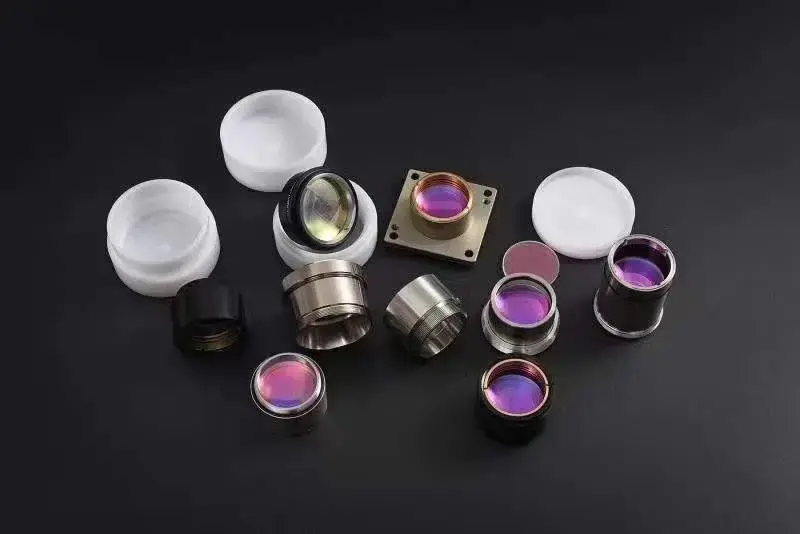
(...Protective lens burned (Check our [High-Power Laser Protective Windows] designed for thermal stability).
Reported symptoms during thick plate cutting:
Protective lens burned
Nozzle overheating
Heavy bottom dross
Large burr formation
Rough edge quality
Unstable cutting consistency
The most common question was: “Is the laser power too high?”
At first glance, the symptoms did appear similar to a high-power instability issue.
But the cut surface itself revealed a deeper process problem.

Caption: Severe Bottom Dross and Unstable Edge Texture During Thick Plate Cutting
What the Cutting Results Revealed
1) Heavy Bottom Dross Accumulation
The molten material wasn’t expelled efficiently from the kerf. Typical symptoms included thick slag hanging on the bottom edge, uneven evacuation, and unstable edge texture. This usually indicates unstable assist gas flow, poor energy concentration, or incorrect focus position.

Caption: Excessive Burr Formation and Molten Material Attachment
2) Large Burr Formation
The edge showed obvious burrs and rough vertical striations. This is commonly associated with excessive cutting speed, insufficient melt removal, degraded gas dynamics, or nozzle deformation.
Burned Nozzle and Lens (A Key Clue)
The protective lens had already been damaged and replaced once.
After replacement, cutting quality improved temporarily.
However, the problem quickly returned.
This is a very important diagnostic clue.
Many operators mistakenly conclude:
“The lens was the root cause.”
But in reality:
The lens replacement only restored optical transmission temporarily.
The underlying process instability still existed.

Caption: Original Cutting Parameters Before Optimization
Focus Position
Cutting Speed
Gas Pressure
Nozzle Condition
Parameter Review
After reviewing the process parameters, several key issues became clear.
The cutting setup showed:
relatively high focus position
aggressive cutting speed
oversized or abnormal nozzle condition
unstable beam centering
Each issue individually can affect thick plate cutting.
Combined together, they create severe instability.
The Real Root Cause Was NOT Laser Power
This case is a perfect example of why thick plate cutting problems are often misdiagnosed.
The laser source itself was not the primary problem.
Instead, the instability originated from process control and optical alignment.
Problem 1: Focus Position Was Too High
(In high-power applications, focus drift is often caused by thermal lens effects in low-quality optics. Upgrading to [UHDT™ Ultra-High Damage Threshold Windows] can minimize this drift.)
When cutting thick carbon steel, focus position is extremely critical.
If the focus is too high:
energy density shifts upward
lower kerf temperature becomes unstable
molten material cannot fully evacuate
bottom dross increases rapidly
The cut edge in this case clearly showed incomplete melt ejection near the lower section.
This is a classic “high focus” symptom.

Caption: Typical Symptoms of Excessively High Focus Position
Problem 2: Cutting Speed Was Too Fast
Excessive cutting speed reduces the interaction time between the laser and the material.
In thick plate cutting, this often causes:
incomplete melting
unstable kerf formation
residual slag attachment
large burr formation
The rough edge texture strongly indicated insufficient melt clearing time.
Problem 3: Nozzle Condition Was Unstable
(When nozzle geometry becomes unstable... Using [Precision Chrome-Plated Nozzles] ensures consistent gas flow and better heat dissipation to prevent erosion.)
The nozzle condition was another major factor.
Possible issues included:
oversized nozzle diameter
nozzle deformation
poor nozzle roundness
When nozzle geometry becomes unstable:
assist gas flow loses symmetry
molten metal evacuation weakens
local overheating increases
burr formation becomes severe
This also explains why the nozzle itself eventually burned.

Caption: Unstable Gas Flow and Nozzle Condition Leading to Severe Burrs
Problem 4: Coaxial Alignment Needed Correction
Beam centering is one of the most overlooked factors in high-power cutting.
If the beam is not perfectly centered:
gas flow becomes uneven
one side overheats
cutting becomes asymmetrical
edge quality deteriorates rapidly
This was visible in the inconsistent cutting texture across the sample edges.
Why Replacing the Lens Only Temporarily Helped
(Frequent lens burnout is a sign of thermal instability. Switching to [UHDT™ Ultra-High Damage Threshold Windows] can help maintain focus consistency even in 20kW+ environments.)
This part is extremely important for many laser operators.
When the burned protective lens was replaced:
beam transmission improved
energy delivery stabilized briefly
cutting quality temporarily recovered
However, because the real process conditions remained unchanged:
incorrect focus
unstable nozzle condition
coaxial deviation
excessive speed
…the instability quickly reappeared.
This is why many shops repeatedly replace consumables without fully solving the problem.
The Optimization Process
After diagnosis, the following adjustments were made:
Process Optimization:
lowered focus position
optimized cutting speed
replaced abnormal nozzle
corrected coaxial alignment
stabilized gas flow condition
The Final Result
After optimization:
bottom dross was significantly reduced
edge quality became smoother
burr formation decreased dramatically
cutting consistency improved
nozzle overheating disappeared
The final cutting surface showed a clean and stable edge profile with far better melt evacuation.
This confirmed that the original issue was process instability — not excessive laser power.

Caption: Final Stable Cutting Result After Focus and Coaxial Optimization
Key Takeaway for Thick Plate Laser Cutting
In high-power fiber laser cutting, many shops immediately suspect:
laser source failure
insufficient power
unstable machine hardware
But in reality, most thick plate quality issues are caused by:
focus deviation
gas instability
nozzle geometry
optical contamination
beam misalignment
As laser power increases, small optical deviations create exponentially larger process instability.
That is why:
stable consumables
precision nozzles
clean optics
accurate coaxial alignment
become increasingly important in heavy-duty cutting applications.
Final Thoughts
This case highlights an important reality in industrial laser processing:
Stable cutting quality is not determined by power alone.
True stability comes from the interaction between:
optics
gas dynamics
focus control
nozzle precision
beam alignment
process tuning
For thick plate cutting especially, small adjustments can create massive differences in production quality and downtime.
Understanding the real root cause is often the difference between:
repeatedly replacing consumables
and
achieving long-term stable cutting performance.
Need Help Diagnosing Similar Cutting Problems?
If your fiber laser system experiences:
heavy bottom dross
unstable thick plate cutting
burned nozzles
excessive burrs
recurring lens contamination
…it may not be a power issue at all.
A proper process and optical diagnosis can often solve the problem far more effectively than simply increasing power or replacing parts repeatedly.
Looking for a complete stability upgrade? Browse our [Nozzle, Ceramic Ring, and Protective Window Catalog] or contact our experts for a free parameter review.


Comments